
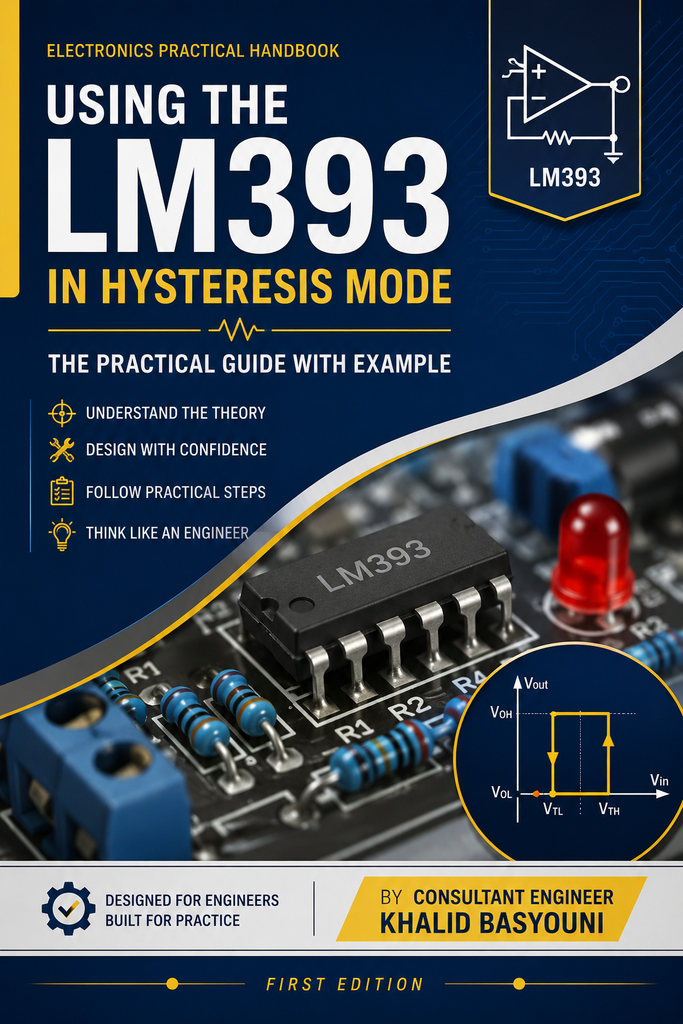
A Practical Guide to Using the LM393 Comparator in Hysteresis Mode
Electronic circuits are expected to make reliable decisions. However, real-world signals are rarely perfect. Electrical noise, slow voltage changes, sensor fluctuations, and interference can cause a comparator to switch repeatedly near its threshold, producing unstable and unreliable operation.
One of the most effective solutions to this problem is hysteresis.
In this practical handbook, Using the LM393 Comparator in Hysteresis Mode, I explain how hysteresis works and how it can be applied using one of the most popular and widely used comparator integrated circuits: the LM393.
This book was written with a simple objective: to bridge the gap between electronic theory and practical circuit design.
Rather than beginning with complicated equations, the book follows the way engineers naturally approach a problem:
- Understand the practical problem.
- Understand how the circuit behaves.
- Develop the mathematical relationships.
- Apply the mathematics to a real design.
- Verify the result and avoid common mistakes.
What You Will Learn
This handbook covers:
- Why comparator hysteresis is necessary.
- How electrical noise causes output chatter.
- How positive feedback creates two switching thresholds.
- The operating principles of the LM393 comparator.
- Non-inverting comparator circuits with hysteresis.
- Inverting comparator circuits with hysteresis.
- Step-by-step mathematical analysis and design equations.
- A complete solved design example.
- Practical resistor-selection considerations.
- Common design mistakes and troubleshooting techniques.
- Quick-reference information for practical circuit design.
Special attention is given to the relationship between circuit behavior and mathematical analysis. Equations are not presented as isolated formulas to memorize. Instead, each mathematical relationship is developed from the physical behavior of the circuit.
The objective is not simply to help the reader build an LM393 circuit.
The objective is to help the reader think like an engineer.
This handbook is intended for:
- Engineering students
- Electronics technicians
- Electronics hobbyists
- Practical circuit designers
- Engineers who want a clearer understanding of comparator hysteresis
Although the LM393 is used throughout the book as the practical example, the engineering principles discussed can also help the reader understand and design hysteresis circuits using other comparators.
About the Author
Khalid Basyouni is a consultant engineer with many years of practical engineering experience and a strong interest in presenting technical knowledge in a clear, logical, and practical manner.
His approach to engineering education is based on a simple principle:
Understand the behavior first. Then use mathematics to describe and design it.
Read or Download the Handbook
The complete handbook is available for reading and downloading:
Using the LM393 Comparator in Hysteresis Mode
A Practical Guide to Understanding, Analyzing, and Designing Comparator Circuits with Hysteresis
I hope this work will be useful to students, technicians, hobbyists, and engineers—and that it will help readers approach electronic circuit design with greater understanding, confidence, and logical thinking.
Leave a Reply